Glass epoxy is a technical composite material widely used across many industrial fields thanks to its combination of electrical insulation, mechanical strength, dimensional stability and reliability. Also known as fiberglass laminate or glass-reinforced epoxy, it is generally produced by impregnating glass fiber fabrics with thermosetting resins, resulting in a material suitable for manufacturing components intended even for particularly demanding operating conditions.
The structure of the material makes it possible to exploit the properties of both the glass fiber and the resin at the same time, making glass epoxy a versatile solution for producing technical parts. However, the most suitable type should be chosen by considering the specific operating conditions, the expected stresses and the electrical and thermal properties required by the application.
Glass Epoxy: Properties and Technical Characteristics
One of the main characteristics of glass epoxy is its high electrical insulating capacity, which allows it to be used for components in electrical and electromechanical systems and equipment. This is complemented by good mechanical strength, which enables the material to withstand stresses and maintain a stable structure during normal component operation.
Glass epoxy also offers good dimensional stability and low moisture absorption compared to other insulating materials. These characteristics can be particularly important when a component must maintain its precision and reliability over time. Depending on the formulation and intended use, several types of glass epoxy are available, including G10, FR4, FR5 and G11, each with its own specific properties and performance.
FR4 glass epoxy, in particular, is widely used in electrical and electronic applications, partly due to its flame-retardant behavior. FR5 glass epoxy, also available in halogen-free formulations, is widely used in the railway sector, where the choice of insulating materials must also take fire safety requirements and fire behavior into account.
Another particularly important type is G11 glass epoxy, valued for its electrical insulating properties and resistance to high temperatures. This material is available in both thermal class F (155 °C) and thermal class H (180 °C), making it possible to select the most suitable solution based on operating conditions and required performance.
In any case, material selection should take into account factors such as operating temperature, mechanical strength, electrical insulation, operating environment and component size.
Glass Epoxy: Industrial Applications and Custom Machining
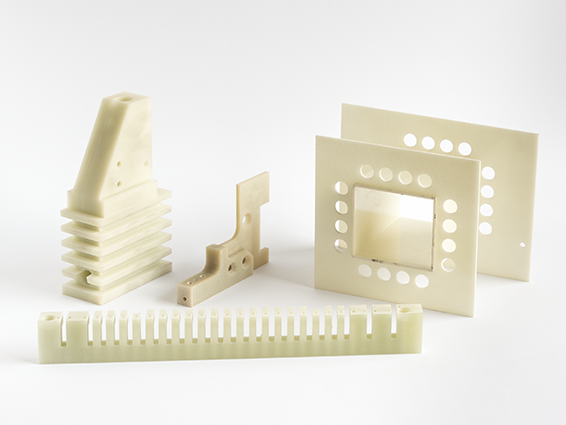
The versatility of glass epoxy allows it to be used to produce a wide range of technical components. The most common applications include insulators, supports, spacers, bushings, washers, panels and custom parts made to drawing. The material is used in the electrical, electronic, electromechanical, mechanical and railway sectors, where insulation and strength must be combined with dimensional precision.
In the railway sector in particular, the use of specific types of halogen-free FR5 glass epoxy makes it possible to meet the needs of applications requiring insulating materials with properties that comply with the safety requirements of this field.
A particularly important aspect for industrial companies is the possibility of custom machining. Starting from a technical drawing or the customer’s specifications, glass epoxy can be machined to produce components with different holes, profiles, thicknesses and geometries, meeting the needs of plants and machinery that require non-standard solutions.
Choosing a partner specialized in machining insulating materials also makes it possible to identify the most suitable material for the application and operating conditions. This results in a component designed to integrate properly into its target system, avoiding generic solutions when specific technical characteristics are required.
For all industrial applications in which electrical insulation, mechanical strength, precision and reliability must go hand in hand, glass epoxy is therefore an extremely versatile material. The ability to select different types and produce custom parts makes it a suitable solution for many of the needs of modern industry.