
How to Choose Electrical Insulating Materials for Industry
Electrical insulating materials play a key role in many industrial sectors, where components must deliver an adequate level of insulation, safety and reliability. Their main function is to prevent the unwanted flow of electric current between conductive parts, helping to protect equipment, installations and operators.
However, the choice of material cannot be based solely on its electrical properties: operating temperature, mechanical strength, moisture behavior, dimensional stability and environmental conditions must also be taken into account.
The most widely used solutions include composite materials and technical laminates such as GPO3 (glass polyester), glass epoxy laminate, Bakelite, Micarta and other materials based on thermosetting resins with textile or glass fiber reinforcements. Each material has specific characteristics and can be selected according to the application.
Among these, GPO3 is one of the main materials machined by Isolmax, thanks to its combination of good dielectric properties, mechanical strength and flame-retardant behavior. In industrial settings, an insulator must often maintain its performance even when exposed to vibration, mechanical stress, temperature changes or continuous use.
GPO3 (Glass Polyester): Properties and Applications
GPO3, also known as glass polyester, is an insulating composite material made of glass fiber and thermosetting polyester resin. Thanks to its structure, it offers an effective combination of electrical insulation, mechanical strength, dimensional stability and flame-retardant behavior, which makes it particularly suitable for a wide range of applications in the electrical engineering sector.
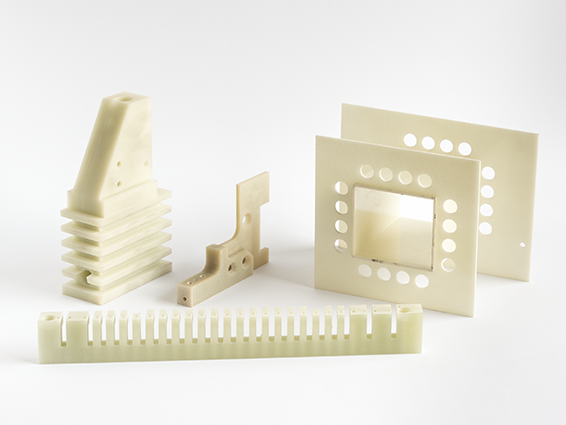
One of the main advantages of GPO3 is that it can be used to produce insulating components for electrical equipment and power distribution systems. The material is used to manufacture insulating supports, spacers, separation barriers, plates, panels and custom technical parts made to drawing.
GPO3 glass polyester also lends itself to a variety of machining processes, making it possible to produce customized components that meet the dimensional and functional requirements of each project. The combination of its electrical and mechanical properties makes it a particularly attractive solution for companies that need reliable and versatile insulating materials.
Electrical Insulating Materials and Precision Machining
The quality of an insulating component depends not only on the raw material used, but also on the precision with which it is turned into the part the customer requires. Drilling, milling, turning, grooving, threading and CNC machining make it possible to produce components with even complex geometries, while meeting the dimensional tolerances defined at the design stage.
For industrial applications, it may therefore be necessary to supply not just sheets or rods, but finished, ready-to-install components, made to the customer’s technical drawings or specifications. It is precisely at this stage that material expertise and production capability become decisive. Improper machining can compromise the material’s properties or cause dimensional defects that make the component unfit for use.
Isolmax specializes in processing insulating and technical materials, with particular expertise in machining GPO3 (glass polyester) and other composite materials for a variety of industrial applications. Its customization-oriented approach makes it possible to start from the project’s requirements and identify, case by case, the most suitable material and machining process.
Industrial Applications of Electrical Insulating Materials
Electrical insulating materials are used in many fields, including electrical installations and equipment, transformers, motors, switchboards, power distribution systems and industrial machinery. They can be used to make supports, spacers, flanges, bushings, plates, guides, insulators and other components designed to electrically separate conductive elements.
In particular, GPO3 (glass polyester) is widely used in the electrical and electrotechnical industry, especially in the production of insulating components for switchboards, distribution equipment and systems that require good dielectric properties combined with a mechanically strong structure.
In many applications, electrical insulation must also be accompanied by specific mechanical and thermal properties. This is why it is important to evaluate the component as a whole, taking into account material, geometry, machining and operating conditions. A material that performs excellently from an electrical standpoint may not be the most suitable solution if it is exposed to high temperatures or particular mechanical stresses.
Working with a specialized partner therefore allows component design to be approached in a more comprehensive way. From the choice of raw material to CNC machining and the dimensional inspection of the finished part, every stage contributes to a product that meets the requirements of the industrial application.
Isolmax combines expertise in technical materials, experience in machining GPO3 and customization capabilities, offering solutions designed not only to insulate, but to integrate effectively into the industrial systems in which they are used.