The ideal choice for every need
In today’s industrial landscape, choosing the right material means making an essential strategic decision. The quality and type of material used have a decisive impact not only on the quality of the final product, but also on other equally important factors: production timelines, performance levels, durability of the finished product, and overall reliability.
Plastic and composite materials are now among the most widespread and versatile components available on the market. Their characteristics—deeply different yet complementary—effectively meet the multiple needs of modern manufacturing, offering specific and functional solutions for every industrial project.
Having access to industrial materials with different technical characteristics allows the manufacturing sector to always identify the most suitable component for its needs, even within the most complex and demanding industrial contexts.
Plastic: versatility par excellence
Widely used across all sectors of industrial production, plastic often represents a cost-effective choice, especially for those seeking a material with a competitive price and high adaptability.
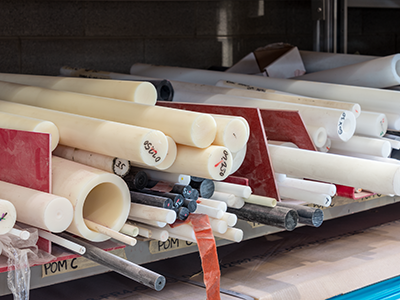
The variants available today are so numerous that they form a true family of materials, valued for the right balance between quality, versatility of use, and ease of processing.
Depending on the type of plastic selected, mechanical properties, quality levels, and long-term durability vary. In recent years, the development of high-performance plastics and the introduction of more sustainable solutions have made this material even more innovative for modern industry.
Today, it is in fact possible to use recyclable polymers or advanced components that maintain the same technical performance as traditional plastic, while simultaneously reducing environmental impact. These new plastics represent a valid alternative to conventional materials, without compromising strength and reliability.
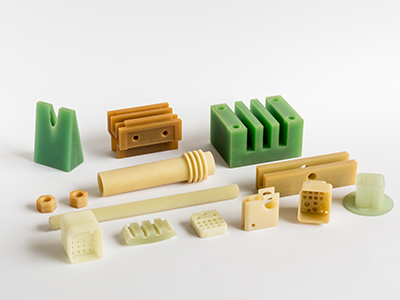
Thanks to its polymeric structure, plastic is ideal for the production of numerous industrial components, including:
- seals;
- protective elements;
- insulating supports;
- housings for industrial and consumer electronics.
All while ensuring stable performance, overall reliability, and a high insulating capacity.
Composite materials: the right choice for demanding environments
Composite materials are designed to meet the most specific production requirements, especially in industrial contexts where high reliability, long-term resistance, and consistent performance are required even under critical conditions.
Created by combining a polymeric matrix with reinforcing materials such as glass fiber or carbon fiber, composites offer very high biomechanical performance, maintaining their characteristics even in the presence of:
- high temperatures;
- high humidity levels;
- prolonged exposure to weathering and wear;
- contact with open flames.
For these reasons, composite materials are widely used in the most technologically advanced industrial sectors, such as aerospace and defense, where thermal stability, extreme resistance, and absolute reliability are required.
A comprehensive response to the needs of modern industry
Thanks to their complementary characteristics, plastics and composite materials represent a comprehensive response to the needs of modern industry. They make it possible to optimize performance without sacrificing component compactness, and allow manufacturers to face production challenges with a practical and customized approach.
A conscious choice of materials therefore means building today the foundations for an efficient, reliable, and competitive production, ready to meet the demands of today’s and tomorrow’s industry.